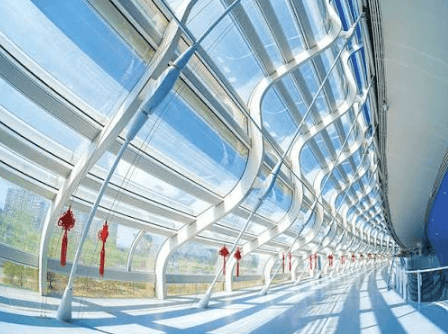
The demand for curved glass continues to grow as designers explore new possibilities for buildings, interiors, furniture, and specialized installations. Behind every successful curved glass product is a carefully managed thermal process.
Glass must be heated and shaped under controlled conditions. If the process is inconsistent, manufacturers may experience dimensional variations, surface concerns, material waste, or production delays. For this reason, thermal control should be treated as a central part of the manufacturing strategy.
Why Temperature Management Matters
Glass responds to heat in a controlled but highly specification-dependent manner. Thickness, size, composition, and desired shape can all influence processing requirements.
Maintaining appropriate thermal conditions allows manufacturers to establish a more predictable forming process.
Operators should monitor equipment readings throughout production rather than assuming that a previously successful setting will always produce identical results.
Establishing Process Parameters
Each product specification should have clearly defined processing parameters. These may include heating conditions, processing duration, movement speed, forming requirements, and cooling settings.
Documenting these parameters makes production more repeatable.
When a new glass specification is introduced, manufacturers can conduct controlled trials and document the results before moving into larger production quantities.
Coordinating Heating and Forming
Heating cannot be considered separately from forming. The glass needs to reach appropriate conditions before the forming stage begins.
Mechanical components should therefore work in coordination with thermal controls. Stable movement helps the material remain correctly positioned as it moves through the process.
Manufacturers should regularly check whether mechanical and thermal systems are operating as expected.
Evaluating Specialized Machinery
The equipment used for bending and strengthening should match the manufacturer’s production requirements. Facilities producing curved products may need machinery designed to support specialized thermal and forming operations.
One product manufacturers may consider during their research is the EASTTEC Radiation Hard Roller Bent Glass Toughening Machine.
When comparing equipment, businesses should examine processing capabilities, control features, maintenance access, production flexibility, and technical support.
Monitoring Heat Distribution
Heat distribution across the glass is an important consideration. Uneven conditions may produce different responses across the same panel.
Regular equipment checks and appropriate calibration procedures can help maintain stable operating conditions.
Production teams should investigate repeated variations rather than treating each defective piece as an isolated event.
Cooling and Final Strengthening
After heating and forming, the cooling stage needs to be controlled according to the product requirements. The transition from high temperature to cooling conditions should be managed consistently.
Cooling performance should be checked as part of routine quality control.
The relationship between heating, forming, and cooling should be considered when troubleshooting production problems.
See also: How Byju’s, Unacademy, and Khan Academy Built Their Tech: Platform Lessons for EdTech Builders
Energy Management
Thermal processing can consume significant energy, making energy management relevant to overall manufacturing costs.
Factories can monitor energy use and review equipment operation for unnecessary consumption. Proper maintenance may also help systems operate more efficiently.
Energy performance should be evaluated alongside production output and product quality rather than considered separately.
Preventive Maintenance
Thermal equipment operates under demanding conditions. Components exposed to high temperatures and repeated mechanical movement require regular inspection.
Maintenance teams should follow planned schedules and document completed work.
Early identification of worn components can reduce the possibility of sudden failures during production.
Employee Skills
Technology and operator expertise work together. Employees should understand the relationship between temperature settings, glass specifications, forming, and cooling.
Training should also include safety procedures and basic troubleshooting.
Conclusion
Thermal control is fundamental to reliable glass bending operations. Stable heating, coordinated forming, controlled cooling, equipment maintenance, energy monitoring, and operator training can all contribute to a more consistent manufacturing process. A systematic approach allows manufacturers to manage specialized glass production with greater predictability.
FAQs
1. Why is thermal control important when bending glass?
Controlled thermal conditions help the glass respond more predictably during forming and subsequent processing.
2. What should be considered when selecting equipment?
Manufacturers should consider product specifications, processing capabilities, control systems, maintenance, flexibility, and operating requirements.
3. Can energy monitoring improve production management?
Yes. Monitoring energy consumption can help manufacturers identify unusual usage and evaluate efficiency alongside output and quality.
