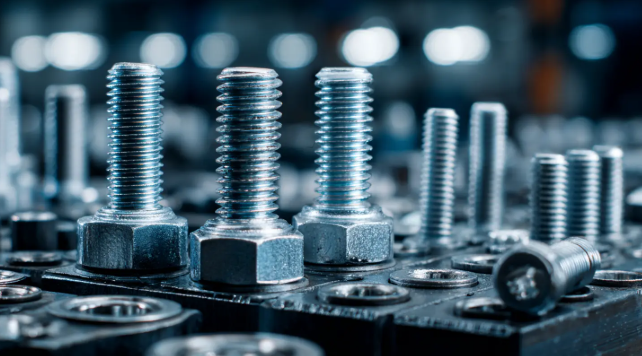
Bolted connections are used throughout industrial manufacturing because they provide a practical way to join components while allowing future disassembly.
The effectiveness of a bolted connection depends on several factors, including the fastener’s material, geometry, dimensions, installation procedure, and interaction with the connected materials.
Understanding these factors helps engineers select components that match their intended applications.
Geometry of the Fastener
Fastener geometry affects both installation and load transfer.
A hexagonal head provides surfaces for applying torque, while an integrated flange increases the bearing area beneath the head.
These features can make the component suitable for assemblies where installation efficiency and surface pressure distribution are important.
Choosing the Material
Material selection should reflect the application’s conditions.
Titanium may be selected for specialized applications where reduced weight and corrosion resistance are valuable. Other metals may provide advantages in different environments.
The engineering specification should determine the final selection.
See also: Improving Laboratory Efficiency With Compact Temperature Equipment
Understanding Bearing Pressure
When a bolt is tightened, the head transfers force into the surface beneath it.
A larger bearing area can distribute this force over a greater region. This is one reason flange-head designs can be useful in selected assemblies.
However, the surrounding material must also be capable of handling the applied load.
Thread Engagement
The threaded portion of the bolt must engage appropriately with the mating component.
Insufficient thread engagement can reduce connection reliability, while excessive engagement may create installation or clearance problems.
The correct engagement should be determined by the joint design.
Installation Torque
Torque is commonly used as a practical method for controlling bolt tightening.
The required value depends on the fastener, joint design, friction conditions, lubrication, and engineering requirements.
Installers should use the specified procedure rather than applying an arbitrary amount of force.
Environmental Conditions
Environmental exposure can influence fastener selection.
Moisture, salt, chemicals, temperature changes, and outdoor conditions can all affect material performance.
Titanium’s corrosion resistance can make it attractive for certain demanding environments, although compatibility should always be evaluated.
Manufacturing Quality
A fastener should meet its specified dimensions and material requirements.
Manufacturers should maintain controls over threading, machining, surface finish, and inspection.
Quality documentation can provide additional assurance for critical applications.
Product Selection
When reviewing a hexagon head flange bolt buyers should confirm the complete technical specification instead of relying only on the product description.
This includes dimensions, material, thread details, flange geometry, and any relevant standards.
FAQs
1. What does the flange do?
It provides a wider bearing surface beneath the bolt head and can help distribute clamping force.
2. Why is torque important?
Proper tightening helps achieve the intended clamping force while reducing the risk of under-tightening or excessive tightening.
3. What environmental factors affect fasteners?
Moisture, chemicals, salt, temperature, vibration, and contact with other metals can influence fastener performance.
Conclusion
Reliable bolted connections result from careful consideration of material, geometry, dimensions, installation, and environment.
A flange-head design can provide practical benefits in suitable assemblies, while titanium may offer advantages where corrosion resistance and weight efficiency are important. Proper engineering specifications and controlled installation remain essential for dependable performance.
