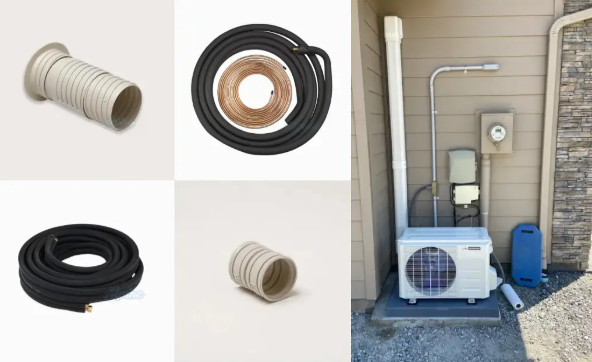
Refrigerant piping is one of the most important physical connections in a split HVAC system. Although the tubing may look relatively simple, its dimensions directly relate to how refrigerant moves between the indoor and outdoor equipment.
When selecting tubing for a mini-split or similar HVAC application, installers often encounter measurements expressed as fractions of an inch. Understanding what those measurements represent can make product selection and installation planning much easier.
A 1/4 x 3/8 line set identifies a tubing assembly using two different tube diameters. Whether these dimensions are appropriate depends on the requirements of the specific HVAC system.
Why Refrigerant Lines Have Different Diameters
A split-system refrigerant circuit generally uses two pipes with different functions. One side carries refrigerant in one condition while the other returns it through the system.
Because the operating conditions and refrigerant flow requirements differ, manufacturers commonly specify different diameters for the two lines.
The dimensions are therefore not interchangeable. Using tubing with incorrect diameters can affect system operation and may conflict with the manufacturer’s specifications.
See also: Improving Laboratory Efficiency With Compact Temperature Equipment
Always Check the Equipment Manual
The most important rule when selecting refrigerant tubing is to start with the HVAC equipment documentation.
Different systems can require different pipe dimensions even when they appear similar in capacity or design.
Before purchasing a line set, confirm:
- Liquid-line diameter
- Suction-line diameter
- Maximum allowable length
- Maximum elevation difference
- Refrigerant type
- Connection style
- Insulation requirements
The manufacturer’s instructions should be considered the primary source for compatibility.
Understand What the Measurements Mean
A measurement such as 1/4 inch or 3/8 inch refers to the nominal tubing diameter. When two dimensions appear together, they normally represent the two refrigerant tubes in the assembly.
For someone unfamiliar with HVAC terminology, these measurements can seem like minor differences. In practice, however, selecting the correct dimensions is an important technical requirement.
It is therefore useful to keep the equipment model number available when ordering replacement or new tubing.
Length Is Also Important
Diameter is only one part of line-set selection. The total route length matters as well.
An installation may require tubing to travel through walls, along ceilings, around corners, or vertically between floors. The actual path should be measured rather than relying on the straight-line distance.
Longer installations may have additional requirements concerning refrigerant charge or maximum permitted length.
Consider Vertical Separation
Indoor and outdoor units may not always be installed at the same height. For example, the outdoor condenser might be located above or below the indoor unit.
This vertical difference should be checked against the manufacturer’s specified limits.
Installers should document both the total piping length and the elevation difference before installation.
Insulation Protects System Performance
Refrigerant tubing should be appropriately insulated. Insulation helps control unwanted heat transfer and can help manage condensation.
The insulation should fit correctly and remain continuous along the required sections. Damaged areas can reduce its effectiveness.
During installation, the tubing and insulation should also be protected against unnecessary compression or physical damage.
Avoid Excessive Bending
Copper refrigerant tubing can be shaped to follow an installation route, but excessive or improper bending can create problems.
Sharp bends may restrict flow or deform the tube. Appropriate bending tools can help maintain a smoother route.
A well-planned installation minimizes unnecessary turns and leaves enough space for safe handling.
Connection Methods Matter
Depending on the HVAC system, refrigerant lines may use flare connections or other manufacturer-approved methods.
For systems using flares, the tubing end needs to be prepared correctly. Incorrect flaring, contamination, or improper tightening can lead to leakage.
Installers should follow the manufacturer’s instructions and use suitable tools for the connection process.
Keep Tubing Clean
Refrigerant piping should be kept clean and protected from contamination during installation. Dirt, moisture, or foreign material inside the tubing can affect system performance.
When tubing is cut or handled before connection, open ends should be protected as appropriate.
Clean installation practices are particularly important because refrigerant circuits are sensitive to contamination.
Think About the Complete Installation
Choosing tubing should not be treated as an isolated purchasing decision. The line set is part of a complete HVAC installation.
Consider:
- Indoor and outdoor unit positions
- Total route length
- Elevation
- Tubing dimensions
- Insulation
- Connection type
- Electrical requirements
- Condensate drainage
- Service access
Taking these factors into account creates a more organized installation plan.
Common Selection Mistakes
Several simple mistakes can complicate HVAC installation.
One is selecting tubing based only on availability rather than equipment specifications. Another is measuring the distance without accounting for the actual route.
Other common issues include insufficient insulation, excessive bending, poor connection preparation, and failure to check maximum piping limits.
Avoiding these issues starts with careful preparation.
FAQs
1. What does 1/4 x 3/8 refer to in HVAC tubing?
It generally describes two different tube diameters within the same line-set assembly. The exact application must be confirmed against the HVAC manufacturer’s requirements.
2. Can I use a different diameter if the tubing is easier to find?
It is not advisable to substitute tubing without confirming compatibility. The equipment manufacturer specifies the appropriate dimensions for the system.
3. Does line-set length affect HVAC installation?
Yes. Total length and elevation can affect system requirements. Always check the manufacturer’s maximum limits and refrigerant instructions.
Conclusion
Selecting refrigerant tubing involves more than matching two numbers. Diameter, length, elevation, insulation, connection quality, cleanliness, and equipment compatibility all influence the installation.
Understanding these factors allows installers and buyers to make better-informed decisions before purchasing materials. Most importantly, the selected tubing should always match the requirements of the specific HVAC equipment and be installed according to professional and manufacturer-approved procedures.
